

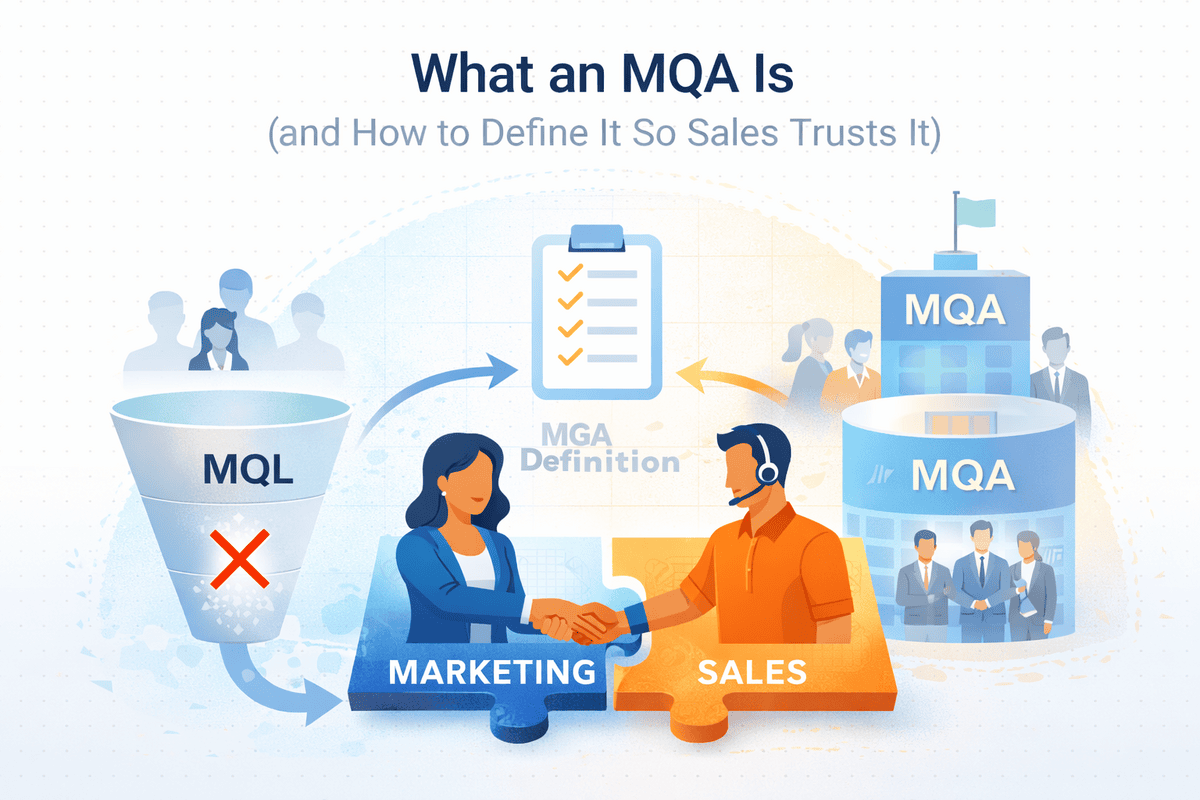
If you replace MQL with “MQA” but nothing changes in Sales behavior, you didn’t modernize your funnel — you just renamed it.
The point of MQAs (Marketing Qualified Accounts) isn’t to create a new label. It’s to create a shared contract between Marketing and Sales that answers:
Which accounts are showing real buying momentum — right now — and what should we do about it?
Why MQAs work better than MQLs
MQLs are person-based and often form-triggered. MQAs reflect how B2B buying actually happens:
- buying committees, not lone leads
- anonymous research before forms
- intent spread across channels and time
- accounts that “warm up” before they “convert”
A Sales-trustworthy MQA definition
Use a definition that includes four non-negotiables:
An MQA is an ICP-fit account showing recent, multi-touch engagement with mid/high-intent content, across one or more personas — indicating active evaluation or buying interest.
That definition works because it forces clarity on:
- Fit: are they your ICP?
- Recency: is this happening now?
- Depth: are they consuming buyer-stage content?
- Breadth: is it spreading across the committee?
The handoff contract (this is the secret)
An MQA is only valuable if it triggers a consistent response.
Make the contract explicit:
- Marketing commits to qualifying accounts using agreed rules
- Sales commits to an SLA (speed-to-lead) and a disposition (accepted / recycle / reject w/ reason)
If you don’t have those, you’ll end up in the same old “lead quality” debate—just with new terminology.
Next in the series: how to score engagement so an MQA is measurable, not subjective.


