

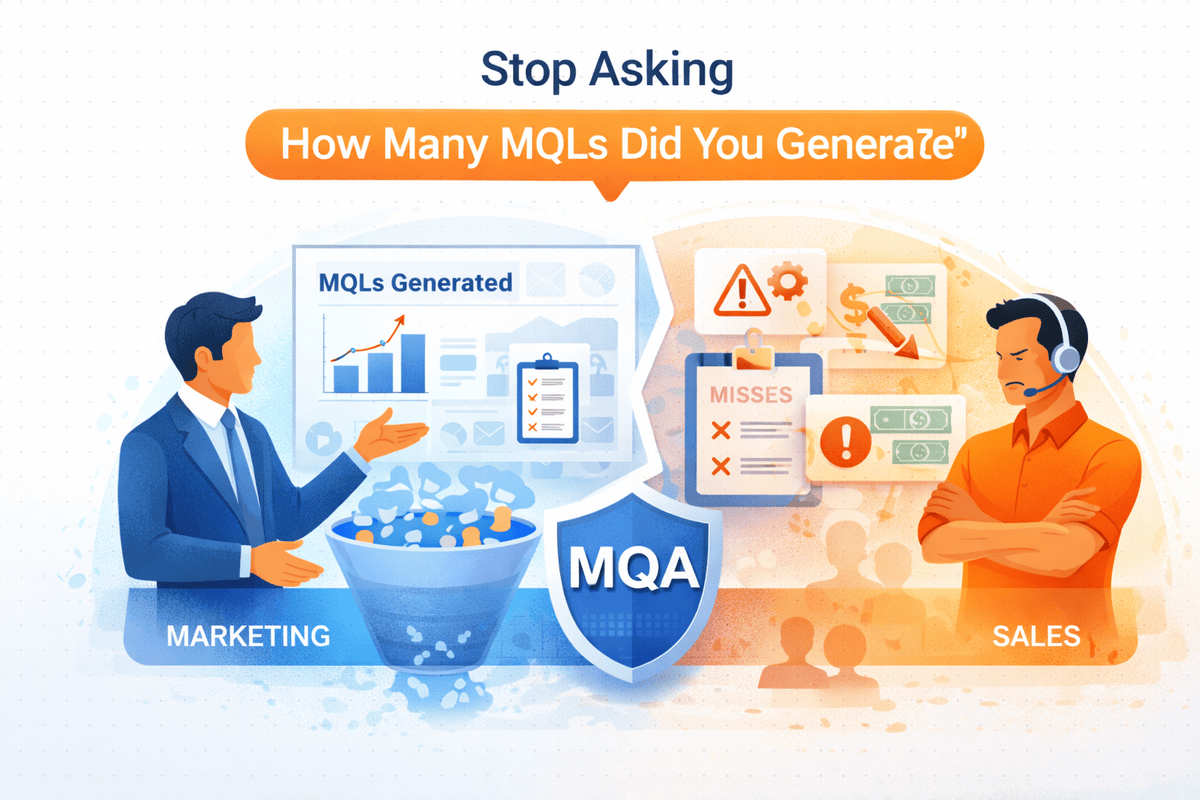

If you’ve led demand gen for any length of time, you’ve heard it:
“How many MQLs did you generate?”
It’s asked in QBRs, pipeline reviews, board decks, and weekly standups like it’s the universal truth of marketing performance.
And to be fair: the MQL can be useful. It’s simple, reportable, and it gives exec teams a number they can track.
But it’s also often the wrong question — because it nudges the org toward volume over value, and it quietly breaks alignment between Marketing and Sales.
Why MQL became “the” metric
MQLs rose to the top because they’re easy to count and easy to optimize:
- gated content forms
- webinar registrations
- demo requests
- scoring thresholds
- “hand it to SDRs when the score hits X”
In a world where the funnel was linear and buyers moved predictably, it mostly worked.
The problem is: buying doesn’t behave like that anymore.
The 3 ways MQLs quietly distort behavior

Even when everyone has good intent, MQLs can create systemic issues:
1) They prioritize quantity over quality
If Marketing is measured primarily on MQL volume, the machine gets tuned to produce more “leads,” not more revenue outcomes.
That tends to drive:
• weaker gating (or over-gating)
• broader targeting
• content optimized for clicks instead of buying progression
• campaigns designed to “hit the number” vs win the account
2) They ignore buying stage and intent
A form fill can mean anything:
• “I’m researching”
• “I need a template”
• “I’m a student”
• “I’m curious”
• “I’m actually buying”
MQLs often collapse those into one bucket, which makes the metric clean… and the signal noisy.
3) They damage trust between Marketing and Sales
Sales teams don’t hate MQLs because they hate marketing.
They hate MQLs because:
• too many aren’t real opportunities
• follow-up feels like wasted effort
• conversion rates don’t match the story
When Marketing gets rewarded for creating “leads” and Sales gets punished for not converting them, you get the classic “lead quality” fight.
The better question: “Which accounts are we deeply engaged with?”
Instead of “How many MQLs?” the more useful question is:
How many marketing-qualified accounts (MQAs) are deeply engaged — and match our ICP — in a way that indicates buying intent?
That shift is subtle but powerful:

From: form fills → To: buying signals
From: people → To: accounts + committees
From: score thresholds → To: meaningful engagement + intent
From: “leads handed off” → To: “accounts progressed”
This aligns much better with how B2B buying actually works:
- multiple stakeholders
- long cycles
- content consumed anonymously
- intent signals spread across channels
- pipeline creation is a team sport


