

The fastest way to kill MQAs is to make them vague.
If “engaged” means everything, it means nothing.
A good MQA scoring model is:
- explainable to Sales and leadership
- consistent week to week
- tied to buying momentum
Here’s a framework that works across most B2B SaaS/cyber orgs.
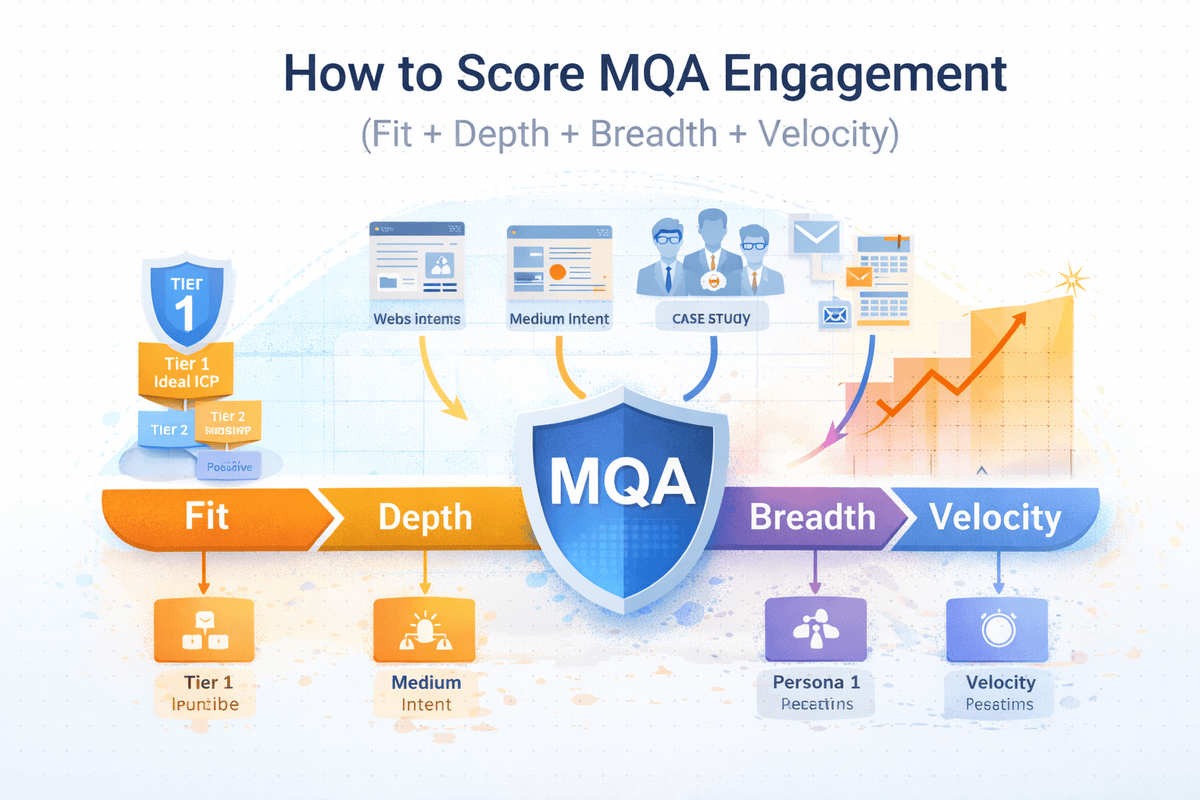
The 4-part MQA engagement model
1) Fit (gate, not a goal)
Fit is mostly static and should act like a filter:
- Tier 1: Ideal ICP
- Tier 2: Strong ICP
- Tier 3: Possible / edge
- Exclude: wrong geo, students, agencies, competitors
Rule: If it’s not Tier 1–2, it can’t become an MQA.
2) Depth (quality of behavior)
Weight actions by buying-stage intent.
Examples:
Low intent
- blog visit, newsletter, social clicks
Medium intent
- solution pages, case studies, product webinars
High intent
- pricing, demo, integrations, comparisons, security/compliance pages
Depth answers: are they doing buyer things?
3) Breadth (committee coverage)
An account isn’t “qualified” if only one person is sniffing around.
Breadth signals:
- 2+ personas engaging
- engagement across functions (security + IT + procurement, etc.)
- multiple domains / multiple users (where you can detect it)
Breadth answers: is interest spreading?
4) Velocity (momentum within a window)
A single spike 60 days ago isn’t momentum.
Velocity signals:
- 3+ sessions in 7 days
- engagement increasing week over week
- spike after a campaign touch or outbound sequence
Velocity answers: is this heating up right now?
A simple, defendable MQA threshold
Start with a rule like:
MQA = (Fit Tier 1–2) AND (Depth: 1 high-intent OR 3 medium-intent) AND (Breadth: 2+ personas OR Velocity spike in last 14 days).
That’s readable, measurable, and tunable.
Next in the series: what to do when an account becomes an MQA — the plays, SLAs, and dashboards that make it operational.


